In short, the answer to the question was most probably no, or is it maybe?
The science in this area remains gray in nature, although as of today, there has been yet another twist in this scientific saga.
--
A number of media reports have appeared today ("n" of 39 at the point of writing) in relation to a case in question in Spain.
Whilst not the first (Court Injunction in place - one wonders why), this is the latest confirmed case of vCJD having occurred twice in the same family. Mother and son. Both have sadly passed away.
I am privy to two "releases" which I have been allowed to share on the web.
The first comes from the Spanish CJD Registry and the second from the UK's National CJD Surveillance Unit.
--
Let us spin back to the Queniborough cluster in the UK, reported in 2001.
None of the victims were related.
--
As has now been reported, in Spain, two of the four victims were related.
Moreover, if as Collinge et al has suggested many times, the incubation period of vCJD is in excess of > 40 years, why did the younger Spaniard succumb and die before the older (and related patient) did?
--
Some food for thought here.
Thursday, 25 September 2008


Wednesday, 24 September 2008
Message from Dr. Zerhouni to nonprofit advocacy organizations
Message from Dr. Zerhouni to nonprofit advocacy organizations - please pass on at his request

24 September 2008 17:35:18
Dear Friends and Colleagues:
Today, with mixed feelings, I wrote to inform NIH scientists, administrators, staff, contractors, and trainees that at the end of October, I will be leaving NIH to explore new opportunities and to devote my attention to several writing projects.
I wanted to also thank and recognize the commitment and tireless efforts of the non profit organizations like yours that help NIH accomplish the great work that it does. For over six years, I have enjoyed and benefited from your thoughtfulness, dedication, and devotion to our shared mission: to make a difference in the nation’s health through the discovery of new knowledge. Together, we have faced great challenges posed by the unique times in which we live and where there are profound changes and shifts in the scientific environment, Government, and the world.
Each one of you is among the most extraordinary, committed group of individuals with which I have ever interacted. Whenever NIH asks for your ideas, input, suggestions, and, participation, you answer the call, regardless of the nature and the complexity of the question, concern, or issue under discussion. You have every right to share credit for the agency’s achievements as you form a unique and essential component of our success. It is also because of you that NIH is one of the true “wonders of the world” and takes such a prominent place in rankings of Federal agencies.
NIH is the “Nation’s Medical Research Agency,” and with your continued guidance, support, and volunteerism, the agency will remain on the leading edge of health, medical, and scientific advancement. Our continued success depends on nothing less. I want to sincerely thank you for your kind support during my tenure.
Please feel free to distribute this message to your officers, advisors, and members.
Elias A. Zerhouni, M.D.

24 September 2008 17:35:18
Dear Friends and Colleagues:
Today, with mixed feelings, I wrote to inform NIH scientists, administrators, staff, contractors, and trainees that at the end of October, I will be leaving NIH to explore new opportunities and to devote my attention to several writing projects.
I wanted to also thank and recognize the commitment and tireless efforts of the non profit organizations like yours that help NIH accomplish the great work that it does. For over six years, I have enjoyed and benefited from your thoughtfulness, dedication, and devotion to our shared mission: to make a difference in the nation’s health through the discovery of new knowledge. Together, we have faced great challenges posed by the unique times in which we live and where there are profound changes and shifts in the scientific environment, Government, and the world.
Each one of you is among the most extraordinary, committed group of individuals with which I have ever interacted. Whenever NIH asks for your ideas, input, suggestions, and, participation, you answer the call, regardless of the nature and the complexity of the question, concern, or issue under discussion. You have every right to share credit for the agency’s achievements as you form a unique and essential component of our success. It is also because of you that NIH is one of the true “wonders of the world” and takes such a prominent place in rankings of Federal agencies.
NIH is the “Nation’s Medical Research Agency,” and with your continued guidance, support, and volunteerism, the agency will remain on the leading edge of health, medical, and scientific advancement. Our continued success depends on nothing less. I want to sincerely thank you for your kind support during my tenure.
Please feel free to distribute this message to your officers, advisors, and members.
Elias A. Zerhouni, M.D.
Sunday, 21 September 2008
The Days of Print Are (almost) Over

Yesterday, whilst trawing through the stunningly massive content of the Scribd library/database, I found three e-books in PDF format of particular interest.
To me? absolutely, people at large but also, the 230 or so who form part of the "The Life Scientists" room over at FriendFeed.
Now, I've uploaded a few bits and bobs to Scribd, but until yesterday, had not properly searched the database. I found this (Scribd database) quite astonishing in terms of level/depth, and content generally.
--
Being someone who is very interested in Glycobiology, that was what I threw into the Scribd engine.
Result was 102 at full article level.
What I found more interesting however was the fact that I was able to download some rather amazing resources which I simply had to alert others to and did so via FriendFeed. These were:-
1) Oxford Dictionary of Science Fifth Edition (893 pages - free PDF download)
2) 'Encyclopedic Reference of Genomics and Proteomics in Molecular Medicine' (2117 pages - free PDF)
and a drum roll please - thanks
3) 'The Reactome Book' - "A textbook of biological pathways" (3252 pages - free PDF)
Now of course, we should be talking quality not quantity and correctly so. That said, it didn't take long to virtually browse through this e-library and bookmark a few items of interest, not so much for myself I hasten to add, but to share with actual life scientists.
So, in the space of a couple of hours, that's ~ 7000 pages of quality text book material, shared to others. Cool.
Science Blogging 2008: London - Keynote Speaker - Ben Goldacre, Video
Whilst we await formal video footage from the Royal Institution of Science Blogging 2008: London, I noted that Cameron Neylon has uploaded some further footage to the web.
For those who haven't seen it, Dr Ben Goldacre's blog is called Bad Science.
Without any further ado, here is Ben's 30 minute talk:-
For those who haven't seen it, Dr Ben Goldacre's blog is called Bad Science.
Without any further ado, here is Ben's 30 minute talk:-
Thursday, 18 September 2008
Pork Connective Tissue and Ham Tortellini
A quick scan in the fridge this morning to allow me to ponder what to have for dinner when I got back from work. Oh, there’s a couple of packs of fresh Tortellini. Of the two, the Pork and Ham one was the more appealing. Purely out of interest, I glanced at the ingredients label, and boy, I wish I hadn’t done that !!!!! Why? Here’s why.
About half way through the list, pork connective tissue is clearly labelled. Now doesn’t that sound darn tasty.
During my 4 year stint with a UK Charity from 2001 – 2005, this led to a number of meetings/discussions/emails with the UK’s Food Standards Agency (FSA) right up to the highest level. This was all namely in light of BSE related issues. As such, McDawg is more than probably a bit more knowledgeable than “your man on the Clapham Omnibus” about specified risk material, mechanically recovered meat etc.
I’ve known for a while that the FSA have been calling for more informative labelling generally including providing more information about country of origin, actual type of meat/meat product etc.
--
So what exactly is mammalian connective tissue? I had a rough idea in the sense that this is not meat. Here’s the wiki page on connective tissue.

Also see the following from the Guardian in 2006; How processed is the food you eat?
“'Reclaimed' meat, such as pork connective tissue, is common in cheap meat-based products such as paté and sausages. Made from the last scraps of meat and offal left on the carcass after the more nutritious cuts of meat have been removed, it goes through a number of processes in order to make it palatable.”
That aside, I’ve enjoyed eating “Pork” and Ham/Mascarpone etc. Tortellini for a long time and will probably return to this again but just not right now.
Having said all that, now that I'm back home and have re-read the label, things ain't as bad as I initially thought. The product does actually contain Pork AND Pork Connective Tissue. I'm still too grossed out though by the yuk factor at the moment so I'll probably freeze the product and consume at a later date.
So, I can really say nothing more than….. “Pork Connective Tissue and Ham Tortellini…….. you are the weakest link – goodbye”.
About half way through the list, pork connective tissue is clearly labelled. Now doesn’t that sound darn tasty.
During my 4 year stint with a UK Charity from 2001 – 2005, this led to a number of meetings/discussions/emails with the UK’s Food Standards Agency (FSA) right up to the highest level. This was all namely in light of BSE related issues. As such, McDawg is more than probably a bit more knowledgeable than “your man on the Clapham Omnibus” about specified risk material, mechanically recovered meat etc.
I’ve known for a while that the FSA have been calling for more informative labelling generally including providing more information about country of origin, actual type of meat/meat product etc.
--
So what exactly is mammalian connective tissue? I had a rough idea in the sense that this is not meat. Here’s the wiki page on connective tissue.

Also see the following from the Guardian in 2006; How processed is the food you eat?
“'Reclaimed' meat, such as pork connective tissue, is common in cheap meat-based products such as paté and sausages. Made from the last scraps of meat and offal left on the carcass after the more nutritious cuts of meat have been removed, it goes through a number of processes in order to make it palatable.”
That aside, I’ve enjoyed eating “Pork” and Ham/Mascarpone etc. Tortellini for a long time and will probably return to this again but just not right now.
Having said all that, now that I'm back home and have re-read the label, things ain't as bad as I initially thought. The product does actually contain Pork AND Pork Connective Tissue. I'm still too grossed out though by the yuk factor at the moment so I'll probably freeze the product and consume at a later date.
So, I can really say nothing more than….. “Pork Connective Tissue and Ham Tortellini…….. you are the weakest link – goodbye”.
Wednesday, 10 September 2008
BBC FREE
Great full page article in today's (free) Metro newspaper entitled, "Web TV: The next generation". As far as I know, the article is not online.
The top of the page in question reads, "EXTRA-TERRESTRIAL VIEWING TELEVISION SCHEDULES WILL SOON BE A THING OF THE PAST, AS FIONA MACDONALD DISCOVERS
From the abstract:-
From Saturday, telly addicts will be able to experience a new on-demand service from the BBC: iPlayer is introducing 'Series Stacking', allowing us to catch up on every episode of selected shows. As the BBC's controller of Multiplatform, Simon Nelson, puts it: 'Now, you'll be able to join a series half way through, following a friend's recommendation, for example, and catch up on all the previous episodes - or watch them all in one go over a weekend.' But how does that fit in with BBC's remit? And with the onset of internet TV, will a new small screen be taking pride of place in our living rooms? In a brave new broadcasting world, we've produced a TV guide that might prove more handy than any schedules.
The BBC introduced their revolutionary iPlayer service about 8 months ago. Fantastic service I have to say. As matters stand, content is currently available for 7 days after broadcast.
From Saturday however, this changes big style. IMHO, this is a truly bold and significant move (in the right direction) by the BBC and other will surely follow. Over the years, I've made more connections with folks at the BBC than any other media corporation/company and news like this is most certainly "music" to McDawg's eyes/ears and that of millions of others.
Follows the opening para from Fiona MacDonald's excellent article:-
With digital taking over our viewing has gone extra-terrestrial. In the eight months since it fully launched, BBCi Player has proven a bigger hit than anticipated: according to the internet service provider PlusNet, streaming is now 168.9 per cent higher per day. 'In five years, it's likely people will watch content on their computer, whenever they want.' says PlusNet's Neil Armstrong. 'Traditional TV schedules will be thrown out of the window. '
snip..
iPlayer is expected to have 1 million daily users by Christmas, yet none of them need a TV licence if they watch material after it has been broadcast on TV.
The article also contains news of other cool developments to follow in the near future all of which are equally exciting.
Well done BBC !!!

The top of the page in question reads, "EXTRA-TERRESTRIAL VIEWING TELEVISION SCHEDULES WILL SOON BE A THING OF THE PAST, AS FIONA MACDONALD DISCOVERS
From the abstract:-
From Saturday, telly addicts will be able to experience a new on-demand service from the BBC: iPlayer is introducing 'Series Stacking', allowing us to catch up on every episode of selected shows. As the BBC's controller of Multiplatform, Simon Nelson, puts it: 'Now, you'll be able to join a series half way through, following a friend's recommendation, for example, and catch up on all the previous episodes - or watch them all in one go over a weekend.' But how does that fit in with BBC's remit? And with the onset of internet TV, will a new small screen be taking pride of place in our living rooms? In a brave new broadcasting world, we've produced a TV guide that might prove more handy than any schedules.
The BBC introduced their revolutionary iPlayer service about 8 months ago. Fantastic service I have to say. As matters stand, content is currently available for 7 days after broadcast.
From Saturday however, this changes big style. IMHO, this is a truly bold and significant move (in the right direction) by the BBC and other will surely follow. Over the years, I've made more connections with folks at the BBC than any other media corporation/company and news like this is most certainly "music" to McDawg's eyes/ears and that of millions of others.
Follows the opening para from Fiona MacDonald's excellent article:-
With digital taking over our viewing has gone extra-terrestrial. In the eight months since it fully launched, BBCi Player has proven a bigger hit than anticipated: according to the internet service provider PlusNet, streaming is now 168.9 per cent higher per day. 'In five years, it's likely people will watch content on their computer, whenever they want.' says PlusNet's Neil Armstrong. 'Traditional TV schedules will be thrown out of the window. '
snip..
iPlayer is expected to have 1 million daily users by Christmas, yet none of them need a TV licence if they watch material after it has been broadcast on TV.
The article also contains news of other cool developments to follow in the near future all of which are equally exciting.
Well done BBC !!!

Saturday, 6 September 2008
Why Glycobiology? Here's why
Ever since McDawg was introduced to the field of Glycobiology early 2003, he's remained firmly hooked.
I spotted an excellent new article today via Google News from Science Daily.
In my chosen role as a Patient Advocate, this stimulated me to post something of substance on one of the Forum's that I frequent from time to time. The one in question is 'closed' to non-Forum users since those who are registered, are mostly patients/carers and data/personal information is free for all to see. It's called, PatientsLikeMe. PLM for short.
I've been part of PLM's ALS/MND community for nearly two years now.
--
After that introduction, whilst I've not posted anything on that particular Forum for a while, follows a copy of my most recent comment, uploaded today.
---
Earlier on today, I spotted something rather important so I wish to bring this up on PLM. This is most probably worthy of a thread of it's own, however, I've chosen to post it on this thread after giving this some thought.
This to me is the most recent further evidence of the importance of Glycobiology as a research field and the wide implications this has when studying diseases both objectively and subjectively.
Rather than starting a new thread however, I thought it was not a bad idea to continue to post items related to Glycobiology under the same roof as it were - hence, why I chose here.
Before I get to the reason for posting this entry, I wish to continue the theme of updating progress (re. my research) generally as per previous posts on this thread.
--
I can report the following:-
a) Last Saturday, Professor Peter Murray-Rust and I met in person for the first time and got stuck into writing our Manuscript "Access to Published Medicine: A Universal Right" Thankfully, our paths met at this Conference and as was publicly announced in the wrap up session by Peter, the stage was set for writing. Up till then, we had made some progress online, but in the end, it required a physical meet up to get things moving along.
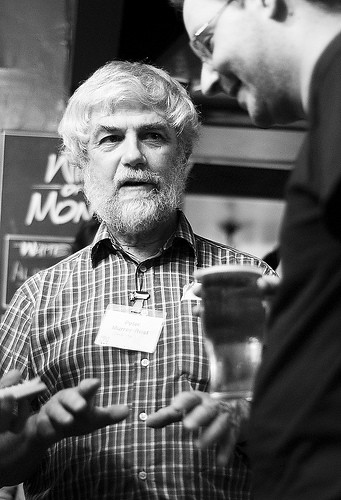
Here we are chatting during a Manuscript writing 'tea break':-
(the Prof is the bearded one)
b) I continue to make progress on points b) and c) above. A few other co-authors (undergrad to PhD to Professor) from various countries have joined those who have already agreed to write up the next two chapters of this set of Manuscripts. One is namely ALS/MND orientated, the other, a more general review of protein misfolding diseases and published/unpublished data/research. All of my/our research is destined for Open Access Journals.
c) I'm particularly attracted to the ethos of Open Science. Discussing and sharing thoughts/ideas/data about new research ahead of publication in a peer reviewed journal - very much what we do here at PLM !! There's a great new feature article about this entitled "Era of scientific secrecy nears its end" over at MSNBC which is well worth a read. Moreover, having at last met (also last weekend) the key scientists who are leading the way, this drew it home to me that this can be done, and is being done.
--
So, without further ado, here is:- "Do 68 Molecules Hold The Key To Understanding Disease?" from Science Daily 4th Sept 2008. I have previously had contact with both Prof Jamey Marth and Prof Ajit Varki who are world leaders in the field of Glycobiology.
"Like the periodic table of elements, first published in 1869 by Russian chemist Dmitri Mendeleev, is to chemistry, Marth’s visual metaphor offers a new framework for biologists."
I spotted an excellent new article today via Google News from Science Daily.
In my chosen role as a Patient Advocate, this stimulated me to post something of substance on one of the Forum's that I frequent from time to time. The one in question is 'closed' to non-Forum users since those who are registered, are mostly patients/carers and data/personal information is free for all to see. It's called, PatientsLikeMe. PLM for short.
I've been part of PLM's ALS/MND community for nearly two years now.
--
After that introduction, whilst I've not posted anything on that particular Forum for a while, follows a copy of my most recent comment, uploaded today.
---
Earlier on today, I spotted something rather important so I wish to bring this up on PLM. This is most probably worthy of a thread of it's own, however, I've chosen to post it on this thread after giving this some thought.
This to me is the most recent further evidence of the importance of Glycobiology as a research field and the wide implications this has when studying diseases both objectively and subjectively.
Rather than starting a new thread however, I thought it was not a bad idea to continue to post items related to Glycobiology under the same roof as it were - hence, why I chose here.
Before I get to the reason for posting this entry, I wish to continue the theme of updating progress (re. my research) generally as per previous posts on this thread.
--
I can report the following:-
a) Last Saturday, Professor Peter Murray-Rust and I met in person for the first time and got stuck into writing our Manuscript "Access to Published Medicine: A Universal Right" Thankfully, our paths met at this Conference and as was publicly announced in the wrap up session by Peter, the stage was set for writing. Up till then, we had made some progress online, but in the end, it required a physical meet up to get things moving along.
Here we are chatting during a Manuscript writing 'tea break':-
(the Prof is the bearded one)
b) I continue to make progress on points b) and c) above. A few other co-authors (undergrad to PhD to Professor) from various countries have joined those who have already agreed to write up the next two chapters of this set of Manuscripts. One is namely ALS/MND orientated, the other, a more general review of protein misfolding diseases and published/unpublished data/research. All of my/our research is destined for Open Access Journals.
c) I'm particularly attracted to the ethos of Open Science. Discussing and sharing thoughts/ideas/data about new research ahead of publication in a peer reviewed journal - very much what we do here at PLM !! There's a great new feature article about this entitled "Era of scientific secrecy nears its end" over at MSNBC which is well worth a read. Moreover, having at last met (also last weekend) the key scientists who are leading the way, this drew it home to me that this can be done, and is being done.
--
So, without further ado, here is:- "Do 68 Molecules Hold The Key To Understanding Disease?" from Science Daily 4th Sept 2008. I have previously had contact with both Prof Jamey Marth and Prof Ajit Varki who are world leaders in the field of Glycobiology.
"Like the periodic table of elements, first published in 1869 by Russian chemist Dmitri Mendeleev, is to chemistry, Marth’s visual metaphor offers a new framework for biologists."
Wednesday, 3 September 2008
McDawg's Flickr
Over the last day or so, I've been playing around with Flickr much more than in the past. Indeed until now, I only uploaded one photo there.
I've now shifted over a much larger "n" of images over to Flickr though, and if this works (and it should do - and it does), follows my first embedded Flickr slide-show evah.
For maximum enjoyment, you will need some fine music/wine of your choosing, throw them kids away (for a bit) and dim the lights etc.
Musician/Patient Advocate.
Most of my Flickr creations thus far are "virtual covers" for my musical recordings (where I trade under the name of Steck) which have been uploaded at MacJams.
www.macjams.com/artist/steck
I'm Male and Single.
McBlawg
Galafray, Andromeda but I drop by Somerfield's every second Wednesday - allegedly.
I've now shifted over a much larger "n" of images over to Flickr though, and if this works (and it should do - and it does), follows my first embedded Flickr slide-show evah.
For maximum enjoyment, you will need some fine music/wine of your choosing, throw them kids away (for a bit) and dim the lights etc.
Musician/Patient Advocate.
Most of my Flickr creations thus far are "virtual covers" for my musical recordings (where I trade under the name of Steck) which have been uploaded at MacJams.
www.macjams.com/artist/steck
I'm Male and Single.
McBlawg
Galafray, Andromeda but I drop by Somerfield's every second Wednesday - allegedly.
Tuesday, 2 September 2008
...and this is Planet Earth
The below came through in the form of a thing called email whilst I was away at a Conference.
Astrology is not a McBlawg foci, but I couldn't resist posting this as it's so interesting.


BEYOND OUR SUN . IT'S A BIG UNIVERSE.


ANTARES IS THE 15TH BRIGHTEST STAR IN THE SKY .
IT IS MORE THAN 1000 LIGHT YEARS AWAY.
NOW HOW BIG ARE YOU?
NOW TRY TO WRAP YOUR MIND AROUND THIS.........
THIS IS A HUBBLE TELESCOPE ULTRA DEEP FIELD INFRARED VIEW OF COUNTLESS 'ENTIRE'
GALAXIES BILLIONS OF LIGHT-YEARS AWAY.

BELOW IS A CLOSE UP OF ONE OF THE DARKEST REGIONS OF THE PHOTO ABOVE.

HUMBLING, ISN'T IT?
Astrology is not a McBlawg foci, but I couldn't resist posting this as it's so interesting.


BEYOND OUR SUN . IT'S A BIG UNIVERSE.


ANTARES IS THE 15TH BRIGHTEST STAR IN THE SKY .
IT IS MORE THAN 1000 LIGHT YEARS AWAY.
NOW HOW BIG ARE YOU?
NOW TRY TO WRAP YOUR MIND AROUND THIS.........
THIS IS A HUBBLE TELESCOPE ULTRA DEEP FIELD INFRARED VIEW OF COUNTLESS 'ENTIRE'
GALAXIES BILLIONS OF LIGHT-YEARS AWAY.

BELOW IS A CLOSE UP OF ONE OF THE DARKEST REGIONS OF THE PHOTO ABOVE.

HUMBLING, ISN'T IT?
Sunday, 31 August 2008
"We're Scientists"

McDawg's Match Report on Science Blogging 2008: London
Pleasant train journey from Glasgow (via Edinburgh) to London (Kings Cross) Friday 29th August. Met up with Dr Jennifer Rohn as roughly scheduled and then the Guardian's, James Meikle.
Whilst Jenny and I were waiting for James at the Guardian's reception area, who troops in? None other than Weblebrity Ben fucking Goldacre (he likes to swear you see):-

Never met Ben before although we have exchanged a few emails, the most recent, the day before (since Ben gets gazillions of emails, he didn't immediately recall my name).
NOTE: Ben is the Keynote Speaker tomorrow.
Rough transcription, "So Ben, have you finished preparing your talk for tomorrow?" - Ben, "I haven't thought about it yet" etc. Blimey.
A couple of drinkies and some very interesting chat in a local pub with James and Jenny but with differing schedules, James pissed off to a local Morrisons store for some grub and Jenny and I hoofed it back to where we started off from-ish.
--
Off to Paddington Station for me and a one hour train journey to an undisclosed (sorry) location in Taunton. Was met at the station by a friend as scheduled, couple of drinks at the local pub (such a nice quiet friendly establishment), was treated to a lovely meal back home and crashed without being too late. Who needs Hotels when you have friends/places like this.
Cue Times Like These: Acoustic This is entirely appropriate under the circumstances, plus it's just a bloody great song.
--
Early start, HUGE cooked breakfast (which came in very handy) and returned to the local rail station. A points failure though on the line, all trains cancelled. Shite. Thankfully, the half dozen or so of us commuters were taxied 17 miles to a much larger station and caught an alternative connection back to Paddington.
Quick ride on the London Tubes and arrived about 30 mins. later than scheduled at the Royal Institution (RI) for the event in question. Due to the delay, I had sadly missed Ben's keynote (apparently, he swore shed-loads but they'll bleep 'em out from the yet to be seen video) but there was a long absorbing day still ahead.
--
Are there any bloggers in da house?
When I opened one of the three doors to the Faraday, and peeked inside, I truly felt like a young boy late for his school lesson.
A hundred or so. Fuck, how can I get "into class" unnoticed?
A distant memory which I actually rather enjoyed, if only for a second. I waited. Oh, there's someone else who's also late who's wandered through, so I followed their slipstream unnoticed. I like to be discreet/polite anywhere where I can.

I joined the Conference at the early stages of the first panel discussion.
Now, McDawg being an active member of Nature Network etc. knew many of the attendees by name but not many by face at this juncture.
On the floor, obviously, I recognised Jenny. Oh, next to her must be Anna Kushnir.
In "the audience" who did I spot. Ah, that must be Henry Gee. Is that Bob O'Hara down there - I think so. Now that will be Cameron Neylon. Is that Jean-Claude Bradley sitting beside him? I think so. Oh, and there's Timo Hannay down there. I think that might be Heather Etchever Now that looks like Attila Csordas. There's Ben Goldacre again. Oh, that must be Corie Lok. etc. etc.
Tea/coffee break and my first chance to mingle. Now at this juncture (posted two days post event) I don't intend to report much about the Conference itself in detail since many others have already done so most adequately.
Time to (literally) recharge those batteries? Well yes. Whilst I charged my vid camera overnight - I stupidly left it on play-mode so all the juice had gone. Like an Eagle, I spotted a much in demand spare plug socket and Corie confirmed it was fine to use it. Thanks Corie...
Really superb lunch I have to say c/o the Conf. organisers.

Had lunch with Henry, Bob and Viktor Poór. Since I was still stuck for accommodation (lengthy saga) that night, this came into discussion and within seconds, Mo Costandi's accom. offer was made and accepted straight away. PHEW. That part of my brain could now relax.
After muchos chatting, munching, slurping and networking, everyone headed off for the afternoon sessions.
During the final session "embracing change: taking online science into the future"many interesting things were discussed as one might have expected. Quite unexpectedly, Peter Murray-Rust, whilst talking about blogging and patient advocacy asked me to comment and briefly divulge my background. This I did but having now listened back to the recording of that session, I fully agree with Corie who mentioned later on in the pub that as bloody usual, I spoke too fast. Anna, bless her, commented that she got the general gist though of what I said.
--
Time for a change of T shirt before we commenced networking post Conf. I found what I thought was a quiet spot (broom cupboard) to change but was caught in the nude with, sorry by a Nature employee. She's since recovered.
After that, on went one of my two navy blue PLoS ONE T shirts, quick spray of body de-od, clipped the name badge on again and completed the transformation/pit-stop in under 19.56 seconds thus setting a new 'personal best' in the process. Nice.
Rejoined the masses and lost track of the number of people who made comments such as, "weren't you wearing orange a few moments ago?". "Yes, I replied, I just fancied a change". Fair enough.
--
My gosh, the bar at the RI is a tad expensive :-(
--
Off to the King's Head PH (public house) down the street for the evening. As was announced during the final session, Peter and I found a quiet spot to work on our Manuscript for the OA Journal: Philosophy, Ethics, and Humanities in Medicine PEHM for short. Great to get this back on track but this was a tad anti-social. Matters got more complicated though when Mo told me that he was going to be heading home fairly soon. WHAT?? 9.30 on a Saturday with all these fine minds around?? Surely not.
Peter let me go (thanks Peter) and continued writing until he lost power on his laptop. The only plug points available were 2-pin sockets so we couldn't re-charge the laptop or my vid cam. I did spot a double socket just down below but after I attempted a recharge, Peter informed me that he had already tried this but the sockets, and I quote, "don't contain any electrons".
Very thirsty work this Manuscript writing business you know.

Source
--
At closing time (~ 11pm) around a dozen of us wandered off into Soho in an attempt to find a suitable drinking hole. At £10 a head to get in anywhere though, we spent what felt like a lifetime finding "our utopia" for the night. Small, clean, ambient Moroccan restaurant was where we ended up. Well it was ambient till we turned up and loud music started blaring within a minute or so after we sat down.

It was getting late, so time to part company and head into the night. Mo, Attila and I took a cab (well, we think it was a cab) but the science related chat continued to flow.
Our cab driver asks Mo what he did. Mo's reply of "We're scientists" in the context of the situation and indeed the day to me was totally spot on. Now, I is no scientist, but Mo and Attila are. In a way though, I kind of felt that I had morphed into the role of scientist by now, at least for a day. Is it within the remit of a Patient Advocate/anyone to socialise with scientists in this manner? Absolutely, and the more of this, the better.
SCIENTISTS ARE HUMAN BEINGS
We dropped Attila off, hit Mo's, Mo and I had a couple of cups of tea before shut-eye. Big thanks to Mo for letting me crash over. Much appreciated Mo.
--
As it happened, we both chose to wear our new sciblog T shirts the next day. Tube was down so took a bus to Victoria and parted company. Several hours later, I was back in Glasgow but turned a number of heads with my latest science slogan bearing garment along the way.
--
All in all, what a really fantastic bunch of cool, intelligent, creative and friendly people and Richard P. Grant. I was one of the lessor experienced bloggers but I came away with much to contemplate.
Sign O' The Times.
Monday, 18 August 2008
How to play a Podcast
Phew. That's better.
Welcome back to Who Wants to Be A Beekeeper.
"I'm your host, Chris Tarentless."

"OK, OK.I've got Dr Henry Gee here who's stuck, and is one question away from winning a whopping million pence (one pence a year)."
Henry asks to phone a friend.
Dramatic music ending with a ping
"Dr Grant, Hello, it's Chris Tarentless from Who Wants to be a Beekeeper."
"Hello, Dr Grant here."
"OK, Dr Gee is stuck on the following question, but is one step away from tonight's Jackpot"
"Hi Henry"
"Hello Richard"
Chris
"OK, the final question is, how do you open a podcast file. Henry's had some difficulties earlier in the show on this question, so can you help him?"
Richard
"I'll certainly try Chris"
Dramatic music ending with an even louder ping
Cameraman "B" then spins back to Henry's uncertainties:-
"Sorry, Graham: any audio technology substantially in advance of this"

"Searching for Her Master’s Voice"
"is beyond my ability to comprehend. If you happen to have it on a wax cylinder, perhaps you could bring it to the blogathon?"
"Yes, I tried that, but my adapter was the wrong size. Or perhaps I needed new batteries."
"Yes. And also because 18.5 Mb is more Mb than I can eat."
-
Dull music starting with a quiet bong
Chris
"OK, Henry, you've called a friend - what's your final answer"
Is it:-
A) do some gardening
B) hit CTR-ALT-DEL and hope for the best
C) click on the play button
D) throw the bastarding machine out the nearest window
Welcome back to Who Wants to Be A Beekeeper.
"I'm your host, Chris Tarentless."

"OK, OK.I've got Dr Henry Gee here who's stuck, and is one question away from winning a whopping million pence (one pence a year)."
Henry asks to phone a friend.
Dramatic music ending with a ping
"Dr Grant, Hello, it's Chris Tarentless from Who Wants to be a Beekeeper."
"Hello, Dr Grant here."
"OK, Dr Gee is stuck on the following question, but is one step away from tonight's Jackpot"
"Hi Henry"
"Hello Richard"
Chris
"OK, the final question is, how do you open a podcast file. Henry's had some difficulties earlier in the show on this question, so can you help him?"
Richard
"I'll certainly try Chris"
Dramatic music ending with an even louder ping
Cameraman "B" then spins back to Henry's uncertainties:-
"Sorry, Graham: any audio technology substantially in advance of this"

"Searching for Her Master’s Voice"
"is beyond my ability to comprehend. If you happen to have it on a wax cylinder, perhaps you could bring it to the blogathon?"
"Yes, I tried that, but my adapter was the wrong size. Or perhaps I needed new batteries."
"Yes. And also because 18.5 Mb is more Mb than I can eat."
-
Dull music starting with a quiet bong
Chris
"OK, Henry, you've called a friend - what's your final answer"
Is it:-
A) do some gardening
B) hit CTR-ALT-DEL and hope for the best
C) click on the play button
D) throw the bastarding machine out the nearest window
Sunday, 17 August 2008
The International Gang of Four (IGF)

Source: Norma Desmond's Flickr Photostream
Here's a wee story I'd like to share in real time.
In order to respect privacy, I've changed the names and omitted the nature of disease topic. In the grander scheme of things, what we're doing is equally applicable to any condition anyway.
ONLINE COLLABORATION
My involvement in Patient Advocacy leads to a vast array of interesting avenues. On one of the Forum's that McDawg frequents, off Forum, I've made contact with a few folks in particular who post extremely interesting and thought provoking comments and are clearly, very intelligent people. The majority of these comments are accompanied with links to abstracts in PubMed.
Now, I'm not suggesting at all that the content of posts from others are not of value. Far from it. Everyone has something to offer. Having navigated these waters for a number of years now, users of the Forum would be the first to agree however that some people do very much stand out from the crowd. I'm not one of them but my "connecting people" skills is appreciated there.
Last year in particular, the first person unbeknown to anyone at that time to be "recruited" to the IGF was "Margaret" in Australia and then "Laura" in New Zealand a few weeks later. Broadly speaking, we've all gathered a lot of useful information and share much common ground. Our backgrounds are all quite different but we all very much have a reason for being interested in a particular disease.
This year, off Forum, contact was established with "Thomas" in Canada. We all started off emailing each other separately and this gradually started to morph into something bigger - more collective.
Thomas proposed that it would be a good idea or formally structure what we were doing, and also proposed the name of the International Gang of Four and since all were in agreement, that's how we formed the IGF.
This also ties in very nicely with a Review Manuscript I was already working on about the disease.
"Julie" from the USA has been the most recent addition a month or so ago. Now that we are up to five, we're still trading at the IGF but the "F" now represents five, not four.
--
Rather than all working separately, I proposed that we should collaborate online using Google Docs. Some of us are more advanced than others in using it, but we're making progress as a team.
We all still contribute to the Forum but in a way, as a group, we sort of outgrew it. Part of "the problem" is that off Forum, we share many Manuscripts using "Fair Use", so are unable to continue with our detailed discussions in a public Forum.
What we are currently doing is uploading our own documents and presentations to Google Docs. At any given moment of time, any member of the IGF can access these, share, remix, whatever. We have a house rule that such access at the moment does not extend to those outwith the group.
This is somewhat ironic for an Open Access Advocate and indeed, someone interested in the concept of Open Notebook Science (ONS) and so on. Indeed, it was contributing to this thread on FriendFeed about writing a Manuscript on ONS and 2.0 social networking science stuff that prompted me to write this post.
So, should the IGF continue to collaborate in the way that we currently are or perhaps experiment with a wiki for example? I would say that we stick with doing what we are currently doing and think about this again at some point in the future.
Once we get to a point where we've actually produced something tangible, where do we go from there? Submit to a Journal for peer review? Most probably.
This is all very much a learning curve for McDawg at least in terms of scientific collaborations but not music collaborations. I've only done this once before (last year) with the end result getting published in Nature Precedings:-
Nature Precedings is a free online service launched in 2007 enabling researchers in the life sciences to rapidly share, discuss and cite preliminary (unpublished) findings. One year later, we look at some of the highlights.
Being a non scientist, a number of questions arise. How do scientists collaborate online? Do many actually do this? Should non scientists venture into such territories? What types of 2.0 tools do people/scientists use to collaborate online?
Subscribe to:
Posts (Atom)


 Posts
Posts