Showing posts with label glycobiology. Show all posts

Friday, 17 October 2008

Essentials of Glycobiology - New Edition is freely available from the NLM/NCBI Bookshelf


As reported today on Open Access News (OAN):-

... Essentials of Glycobiology, the largest and most authoritative text in its field, will be freely available online beginning October 15, through collaboration between the Consortium of Glycobiology Editors, Cold Spring Harbor Laboratory Press, and the National Center for Biotechnology Information (NCBI), a division of the National Library of Medicine (NLM) at the National Institutes of Health (NIH). Fittingly, the release of the book follows soon after the October 14th celebration of International Open Access Day, which will highlight prior successes in providing such open access to research journals. ...

Here is the book. The Foreword is a great place to start of course.

--

OAN Comments:

* Add this to the growing list of widely-used textbooks that are available OA.
* Who's backing this is also noteworthy. It's not an author who negotiated the right to self-archive a copy, or an OA startup publisher; it's a scientific press and the National Library of Medicine.
* The first edition of the book has been OA since 2003. Apparently, the impact on sales of the print copy hasn't been overwhelmingly negative, or it seems unlikely the publisher would support OA to the new edition.

My Comments:


Glycobiology is a most fascinating area that continues to gather interest over time.
I applaud all involved for contributing to and publishing this work to the widest audience on the planet.

Press Release: Novel publishing approach puts textbook in more hands

Saturday, 6 September 2008

Why Glycobiology? Here's why

Ever since McDawg was introduced to the field of Glycobiology early 2003, he's remained firmly hooked.

I spotted an excellent new article today via Google News from Science Daily.

In my chosen role as a Patient Advocate, this stimulated me to post something of substance on one of the Forum's that I frequent from time to time. The one in question is 'closed' to non-Forum users since those who are registered, are mostly patients/carers and data/personal information is free for all to see. It's called, PatientsLikeMe. PLM for short.

I've been part of PLM's ALS/MND community for nearly two years now.

--

After that introduction, whilst I've not posted anything on that particular Forum for a while, follows a copy of my most recent comment, uploaded today.

---

Earlier on today, I spotted something rather important so I wish to bring this up on PLM. This is most probably worthy of a thread of it's own, however, I've chosen to post it on this thread after giving this some thought.

This to me is the most recent further evidence of the importance of Glycobiology as a research field and the wide implications this has when studying diseases both objectively and subjectively.

Rather than starting a new thread however, I thought it was not a bad idea to continue to post items related to Glycobiology under the same roof as it were - hence, why I chose here.

Before I get to the reason for posting this entry, I wish to continue the theme of updating progress (re. my research) generally as per previous posts on this thread.

--

I can report the following:-

a) Last Saturday, Professor Peter Murray-Rust and I met in person for the first time and got stuck into writing our Manuscript "Access to Published Medicine: A Universal Right" Thankfully, our paths met at this Conference and as was publicly announced in the wrap up session by Peter, the stage was set for writing. Up till then, we had made some progress online, but in the end, it required a physical meet up to get things moving along.

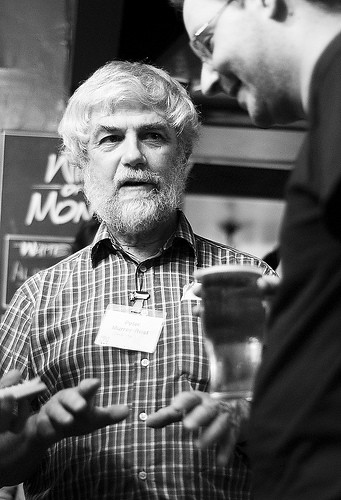
Here we are chatting during a Manuscript writing 'tea break':-


(the Prof is the bearded one)

b) I continue to make progress on points b) and c) above. A few other co-authors (undergrad to PhD to Professor) from various countries have joined those who have already agreed to write up the next two chapters of this set of Manuscripts. One is namely ALS/MND orientated, the other, a more general review of protein misfolding diseases and published/unpublished data/research. All of my/our research is destined for Open Access Journals.

c) I'm particularly attracted to the ethos of Open Science. Discussing and sharing thoughts/ideas/data about new research ahead of publication in a peer reviewed journal - very much what we do here at PLM !! There's a great new feature article about this entitled "Era of scientific secrecy nears its end" over at MSNBC which is well worth a read. Moreover, having at last met (also last weekend) the key scientists who are leading the way, this drew it home to me that this can be done, and is being done.

--

So, without further ado, here is:- "Do 68 Molecules Hold The Key To Understanding Disease?" from Science Daily 4th Sept 2008. I have previously had contact with both Prof Jamey Marth and Prof Ajit Varki who are world leaders in the field of Glycobiology.


"Like the periodic table of elements, first published in 1869 by Russian chemist Dmitri Mendeleev, is to chemistry, Marth’s visual metaphor offers a new framework for biologists."

Saturday, 12 January 2008

Glycobiology - update

Now that I'm blogging more often, I wish to expand further on one aspect of Glycobiology - 21st Century Style which I posted on this blog mid December.

Pentosan Polysulphate (or PPS for short)


PPS was something that I became interested in late 2002. As a result, this led me to become interested in the field of Glycobiology and making contact with at least two dozen leading Glycobiologists from around the world.

Since social networking is all the rage these days, I am currently co-admin of two Glycobiology related online groups, one on Facebook, the other, on Nature Network.

PPS may be a merely a drop in the Glycomics ocean, but it is the substance that I have the greatest knowledge and first hand experience of.

Since my email records only go back to Feb 2006 (I had to change computers and lost a lot of older emails), I cannot recall specifically when contact was made with a Linda Curreri based in Dunedin, New Zealand but it would have been during 2003. We still keep in touch.

Linda maintained a very well referenced and detailed website dedicated to Pentose Sugar. Linda like myself is a layperson but her general research knowledge was and remains sublime. A decision was taken last year by Linda to no longer maintain the site but I offered to come to the rescue if required.

A few months before then however, I had discovered the brilliant WayBackMachine c/o Archive.org

We then knew that despite the site being archived, it would be (and is) preserved perfectly as it was on the web.

I therefore for the first time am providing a link to archived website PENTOSE SUGAR

Further preservation was done in the form of book "Pentosan polysulphate : a medicine made from beech bark" by Linda Curreri early 2007. ISBN 9780473119720 (pbk.) : $12.00

----

At the time of writing, there are 731 Papers about Pentosan archived in PubMed. Importantly however, only 98 are readable (open access) at full article level. That's not a lot really.

When one considers the clinical usages and research areas of PPS, I find it quite staggering that so little research has been published thus far.

Let's take arthritis for example. PubMed throws up over 175,000 Papers. When we add Pentosan to the search mix, the number falls to 32, and down further to only three at full article level.

For a condition that afflicts millions of patients, pretty much to date, only the non-human variety are allowed to receive PPS treatment.

But wait !!. Check out the ARTHOPHARM website in Australia and this page.


Go back, check and FULLY read through archived website PENTOSE SUGAR

Being a layperson and patient advocate with no loyalty to anyone other than patients, no patents pending (or ever likely) and no conflicts of interest to declare, I simply wrote this blog to place information in the public domain.

I will end with a Legal Precedent from 2002 and it's wide ramifications. The following text is from the Pentose Sugar website.

"Law. Pentosan Polysulphate is not and cannot be patented. This places it in the public domain. However PPS is only available under patented trade names which appear on its packaging. This is a complete nonsense, because the brand name is not pentosan polusulphate and it is the trade name which is being marketed. The brand patenting merely protects the commercial property of the manufacturer. If a pharmaceutical company does not ‘develop’ PPS for specific indications and patent their brand name(s) this unique medicine does not become available as a treatment option. In effect legislation made up by law maker’s is blocking pentosan polysulphate’s availability for sick human’s. PPS is however readily available for scientific research.

In the London High Court in December 2002
, Dame Elizabeth Butler-Sloss ruled in favour of two teenagers with advanced vCJD to have pentosan polysulphate to treat this prion disease. The case had absolutely nothing to do with any patented brand name; it was about the right of two dying people to have a medicine that could save their lives .The medicine was the unpatented pentosan polysulphate. Dame Elizabeth’s decision set a precedent and it would seem that the legal constraints which surround this pentose medicine, though firmly in place are flimsy and could in fact be nul and void.

It could also be argued that due to the unique status of pentose sugar in human physiology that it is an absolute right of humans to source and assimilate pentose sugar whether it is a food sweetener or a medicine that has been compounded by a chemist, and neither medical specialists, government officials, man made laws or scientists and pharmaceutical companies ( both of which appear to claim the unpatented generic medicine PPS) have any right to prevent them. Whether by collusion or not, this is indeed happening....globally.

Scientists will always continue research even though principles have been proven, it is what they do, but this should not be used as an excuse to prevent pentosan polysulphate’s use in humans, because science has already proven the safety and worth of this medicine to the human organism."

Monday, 10 December 2007

Glycobiology - 21st Century Style


Glycobiology 21st Century Style

I've been thinking about an 'appropriate' image for this for quite some time, so here we go. All that I added was '21st Century Style'.


SOURCE (C)

Follows some thoughts I had last year.

If accepted for publication, my co-authors and I will deliver something of substance in the New Year.

--

Complex sugar chains and glycosaminoglycan (GAG) side chains
make up an integral part of our mind and body.


It was an Albrecht Kossel who was awarded a Nobel back in 1910 as the first to recognize that nucleic acids contained a carbohydrate. Due to its 5 carbon molecular structure, he called it pentose “the stuff of genes”.


During the first half of the last Century, the chemical and biological structures of carbohydrates were very much a point of focus. Whilst this was to become an integral part of modern day molecular biology, at the time, they were not forerunners unlike other major classes of molecules. Largely, this was due to their (very) complex structures, difficulty in understanding their sequence(s), and the fact that their biosynthesis could not be directly predicted from the DNA template.

53 years ago Nature magazine published a scientific Paper by Maurice Wilkins and his two colleagues at King’s College, London, called “Molecular Structure of Deoxypentose Nucleic Acids” Wilkins M.H.F., A.R. Stokes A.R. & Wilson, H.R. Nature 171, 738-740 (1953)


Something called heparin was “discovered” by a second-year student at John Hopkins University in 1916. By the 1930’s, heparin came into use namely as an anti-coagulant. Essentially, this was made using animal ‘by products’ such as pig, dog and later, bovine gut material. By the early 1940’s, “purified” heparin was available for clinical and experimental use.

Post WW2, Germany was unable to import heparin and there was also a shortage of many basic resources such as sugar. A novel method of deriving synthesized heparin type substances led to the development of sulphanated pentose sugar made essentially from the bark of beechwood trees. The most commonly used term these days for this particular (Polyanion) substance is Pentosan Polysulphate or PPS. Its most common broad (oral) usage commenced in the 1960’s and continues in many countries (namely USA and mainland EU) in relation to the management of the common bladder complaint, internal cystitis (IC). SP54 (the purest form of PPS known continues to be manufactured by a small family run German company, Bene. Here is a page from the Bene website that lists it's currently known broad usages.

Around the same time, Germany, Japan and the (former) Soviet Union also focused on Xylitol which is a five-carbon sugar alcohol, a natural carbohydrate which occurs freely in certain plant parts (for example, in fruits, and also in products made of them) and in the metabolism of humans. Xylitol has been known to organic chemistry at least from the 1890's.


Where there is deficiency or excess of (Proteoglycans) PG’s this can play a lead role in the pathogenesis of a substantial range of common and rare conditions ranging from arthritis, diabetes, cancer, HIV/Aids through to protein folding neuro degenerative conditions such as Alzheimer’s disease (AD).

Semi synthesized HSPG’s (Heparan Sulphate Proteoglycans) over the last few years in particular are now referred to as Glycans. There are 14 Glycans in the family including Glypicans.


In 2005, Nature published a seminal Paper by Professor’s Fuster and Esko (5) entitled “The Sweet and Sour of Cancer: Glycans as Novel Therapeutic Targets” which reported on several significant developments.


In this Paper, Fuster and Esko et al demonstrated the potential use of Glycans in the treatment of many types of cancer/tumor and concluded the Paper with a “(this) might represent the ‘tip of an iceberg’ of therapeutic potential that awaits future discovery” type ending.

Have matters progressed since then?


Glycans have now been brought into real time Clinical usage, namely as surrogate markers in the treatment of a number of cancers.


How far are we from human trials of Glycan use for the likes of HIV, Cancers and Alzheimer’s disease?


Book, ‘Essentials of Glycobiology’ is available online and can be (Open Source)accessed via this book is currently being revised with an updated version was released this year via TA.

The Journal of Glycobiology published its first online Journal in September 1990.


Whilst there has been an increasing wider focus of attention in the Glycobiology field over the last few years in particular, some of the core principles from a cellular level stretch back over a Century.

In Australia and (limited extent) New Zealand in particular, Glycans continue to be used safely and successfully in the treatment of the arthritic joints (osteoarthritis) in both animal and man (1).


The latest reported commentary (2) from the most recent Global Conference on AD in Madrid is highly suggestive that diabetes, whilst certainly not the cause, has a degree of interlinkage with a number of neurodegenerative diseases.

With regards to Alzheimer’s (Amyloidosis generally) despite a substantial number of Peer reviewed published Papers showing Glycan promise in vitro and in vivo, there has been little/no interest from the Pharma Industry.


To sense the ‘sweet flavour’ of the future of Glycobiology in the 21st Century, the word Glycomics comes to mind (3,4).


Are such Generic based approaches deemed as potentially large threats to large Pharma?

(1) PMID:12014849PubMed http://www.ncbi.nlm.nih.gov/entrez/query.fcgi?db=pubmed&cmd=Retrieve&dopt=AbstractPlus&list_uids=12014849&itool=iconabstr&query_hl=5&itool=pubmed_docsum
(2) http://www.wilmingtonstar.com/apps/pbcs.dll/article?AID=/20060722/NEWS/607220330/-1/State
(3) http://www.functionalglycomics.org/static/consortium/main.shtml
(4) http://glycomics.scripps.edu/pub/NatMethodsEditorial2005.pdf
(5) PMID: 16069816 [PubMed - indexed for MEDLINE]http://www.nature.com/nrc/journal/v5/n7/abs/nrc1649.html